


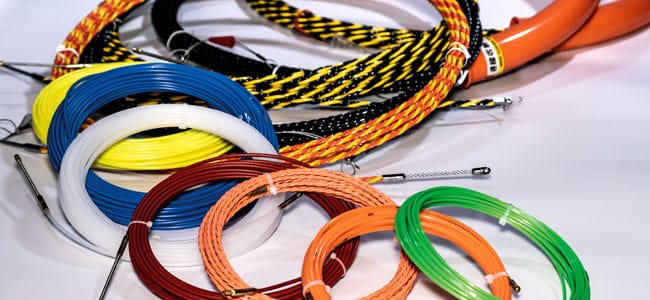
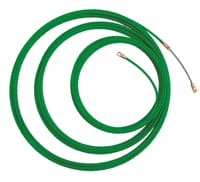
Cable guides are used to introduce and direct wiring through hard-to-reach places. In short, the cable guides make it easy to install the desired wiring. For example: in an office facility, where you want to install a telephone, network and electrical system.
Using a Cable Rail
- Disconnect the electrical power system.
- Insert the guide into the conduit on which work is required.
- To pass it from one end to the other.
- Tie the cable we want to install to our cable guide. Pull the other end to pass it completely.
Features to consider when choosing a cable guide
- Thrust force
- Flexibility
- Tensile strength
- Friction
The pushing force and flexibility are usually inversely proportional, so it is interesting to have several guides depending on the use we have to give it:
- Guides with larger diameters provide greater thrust force, making them ideal for long tubes with few elbows. They will allow the passage of the guide and the cables without the need to make great efforts.
- With guides with a smaller diameter or more flexible materials, we can avoid bends and elbows more easily, as well as passing through corrugated or narrower tubes.
The ability to resist traction is determined by:
- Material
Material Resistance Use Polypropylene 30kgF (100kgF reinforced with steel wire) Domestic Nylon 165kgF (neither splitting nor breaking) Industrial sector
- Nylon guides provide greater resistance than polypropylene ones, and are also characterized by having more flexibility than reinforced
- Diameter
- Quality of the toe setting with the guide.
- Form
The guides can be smooth or HELICAL. The latter are made of polyester, and due to their twisted profile they have a great tensile strength (150KgF), without sacrificing thrust force and flexibility, so they boast great versatility of uses and applications.
The level of friction of the guide with the tube will determine the ease of insertion, so that the new braided or helical models, by reducing the contact surface by up to 50%, require less insertion effort compared to conventional guides.
5 tips to make your guide long-lasting:
- The importance of the toe caps

Unlike conventional tips, the solid bronze tips, threaded and hexagonally pressed provide a perfect hold on the guide, with rounded edges to facilitate movement and prevent stranding. The finder tip has to be flexible to easily adapt to curves and elbows. The fact of having an eyelet on both the finder toe and the handle is a great advantage, as it allows use in both directions, without the danger of deformation or breakage of the toe. - Use the right accessories
There are accessories to facilitate the use of cable guides such as manual pullers, which prevent damage to the user and the material, and cable pass gels to facilitate passage in difficult areas or with many curves, among which glycerin gel stands out, which prevents stains on walls, does not dry out cables and evaporates after 30 minutes from its application. - Facing the tube well with the guide
- Buy a quality guide
- Good maintenance
- The importance of the toe caps

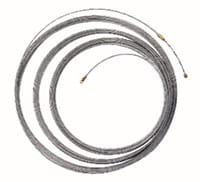
New range of cable guides XB Components
| Reinforced | Nylon | Plastic | Helical Polyester | |||
 | 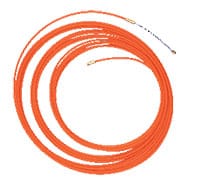 | 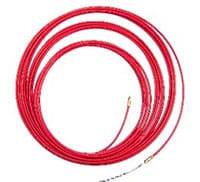 | 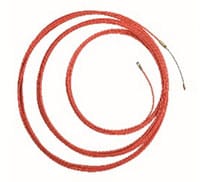 | 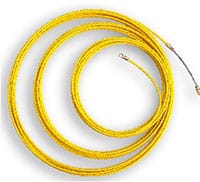 |  | |
| Series | GPR | GPN | GPP | GPH | ||
| Material | Plastic with interior | Nylon | Polypropylene | Solid polyester | ||
| Diameter | 4mm | 4mm | 5mm | 6mm | ||
| Long | 5-10-15-20-25-30m | 10-15-20-25-30-40m | 10-15-20-25-30-40-50-60m | |||
| Color |  |  |  | |  |  |
| Tensile strength | 100KgF | 165KgF | 30KgF | 150KgF | ||
| Friction (contact points) | 2 | 4 | 3 | 1 | ||
| Ideal Tube | 20-32mm | 15-28mm | 25-50mm | |||
| Push Force | Loud | Normal | Casualty | Very high | Maxim | |
| Flexibility | Casualty | Normal | Loud | Loud | ||
Subscribe to our newsletter
Subscribe to our newsletter
We will inform you about news, promotions, events...